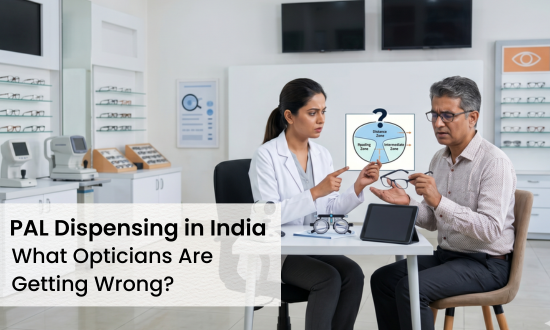

Progressive addition lenses (PALs) are among the most impactful optical solutions available to presbyopic patients. When dispensed correctly, they improve the quality of life significantly. When dispensed poorly, they become an expensive source of frustration for both the patient and the practice.
In my experience working within the Indian optical industry, adaptation failure is one of the most common complaints associated with progressive lenses. In most of these cases, the root cause is not the lens. It is a dispensing decision made before the lens was ever ordered.
Research supports this. A clinical study on spectacle non-tolerance found that dispensing-related issues, including incorrect pupillary distance, inappropriate frame type, and poor fitting, accounted for 58% of patient complaints involving progressive lenses. A separate assessment from Essilor’s technical education team concluded that fixing fitting errors alone could eliminate up to 80% of progressive lens problems.
This article covers the most critical dispensing decisions in progressive lens dispensing in India, from patient selection and lifestyle profiling to frame choice, manual marking, pantoscopic tilt, and adaptation counselling. Each section addresses an area where Indian opticians, particularly those newer to PAL dispensing, frequently make correctable errors.
1. Identifying the Right Patient and the Right Lens for Their Life
The most consequential decision in progressive lens dispensing happens before any measurements are taken. That decision determines whether a progressive lens is appropriate for this patient and, if so, which design suits their lifestyle.
Not every presbyopic patient is a strong progressive candidate from the outset. Patients with significant astigmatism, high refractive errors, or those who have never worn spectacles before may require additional counselling and a more conservative lens choice. For patients who are new to both spectacle wear and presbyopia simultaneously, starting with a reading addition in a single vision lens before transitioning to progressives is sometimes the more prudent clinical recommendation.
For patients who are appropriate candidates, the lifestyle profile determines the lens design. This is where many dispensing conversations fall short. Opticians jump to power and price without asking what the patient actually does with their vision throughout the day.
Lifestyle Profiling: Questions Every Optician Must Ask
- What is your profession? This is key to understanding daily vision demands.
- How many hours a day do you spend driving?
- Do you work extensively on computers or digital screens? At what distance?
- Is reading, whether books, newspapers, or documents, a primary near task?
- Do you work outdoors, in a workshop, or in environments with changing light conditions?
- Have you worn progressive lenses before? If yes, which brand and design?
The answers directly determine corridor length selection, one of the most critical and most frequently overlooked variables in progressive lens dispensing in India.
Corridor Length and Width: A Critical Consideration
Before selecting a lens design, it helps to understand the difference between corridor length and corridor width.
Corridor length is the vertical measurement from the pupillary centre, also called the fitting point, to the centre of the near vision zone where 100% of the addition power is achieved. This distance typically ranges from 11 to 17 mm.
Corridor width is the horizontal measurement of the usable corridor between the aberration zones of the PAL design.
Short corridor lenses, generally 8 to 11 mm, offer a wider distance zone and a wider near zone but produce more pronounced peripheral aberration, commonly called lateral blur or swim effect.
For a patient who drives extensively, a short corridor progressive lens is a poor choice. The peripheral distortion encroaches on the lateral visual field that drivers rely on for awareness of road edges, side mirrors, and peripheral movement. This is not a minor inconvenience. It is a safety concern.
A patient whose primary visual demands are near and intermediate, such as a bookkeeper, surgeon, or student, may benefit from a shorter corridor that brings the near zone into easier reach without excessive head movement. The lens design must serve the patient’s visual life, not the dispensing convenience.
Corridor Reference Guide for PAL Dispensing
| Corridor Type | Length (mm) | Vision Characteristics | Ideal For |
| Short | 8 to 11 | Narrower transition between zones. More peripheral distortion. | Small frames. Near-dominant tasks. |
| Typical | 12 to 16 | Comfortable transitions. Moderate peripheral vision. | Most frame types. General use. |
| Long | 17 to 19 | Wider visual fields. Smooth transitions. Good intermediate vision. | Larger, deeper frames. Drivers. |
2. Measurements: Where Small Errors Have Large Consequences
Monocular pupillary distance (PD) measurement is the single most important fitting parameter for progressive lenses. In some older and narrower designs, the progressive corridor can be as little as 2 mm wide. A measurement error of even 1 mm can place the optical centre outside the corridor entirely, causing the patient to look through a zone of aberration rather than clarity.
Research finding: In a workshop of over 100 dispensing opticians and optometrists asked to measure the PD of a single model patient, results varied by up to 11 mm. Half of the participants could not take the measurement accurately.
Source: Fundamentals of Ophthalmic Dispensing, Optician Online CET Archive
This finding should concern every optical practice. PD measurement is not a task to be delegated to unqualified support staff, performed hastily, or estimated. It requires clinical attention, appropriate tools, and verification.
Monocular vs. Binocular PD: Why Monocular Always Wins for PALs?
Binocular PD gives the total distance between both pupils. Monocular PD gives the distance from each pupil to the nose bridge individually. These two measurements are not interchangeable for progressive lenses.
Facial asymmetry is more common than most patients realise. Using binocular PD and dividing by two assumes perfect symmetry, an assumption that frequently leads to decentration errors, particularly for the near zone. For every progressive lens dispensed, monocular PD must be measured independently for each eye.
PD Meters and Manual Marking: Why Manual Competency Remains Non-Negotiable?
Digital PD meters and optical marking devices have made measurement faster and, when used correctly, more accurate. However, these are tools. They do not replace clinical judgement or manual competency.
Power failures, device calibration drift, lighting conditions, and patient compliance all affect digital measurement accuracy. An optician who cannot take a precise manual PD measurement or manually mark the fitting point on a demo lens is operating with a significant clinical gap.
Every practising optician should maintain the ability to measure monocular PD manually with a pupillometer or millimetre ruler under appropriate lighting, and to manually verify the fitting cross on the demo lens at the pupil centre with the patient in their natural head posture.
Fitting Height: Measured in the Frame, Not in the Abstract
Fitting height is the vertical distance from the pupil centre to the lowest point of the lens in the chosen frame. It must be measured with the patient wearing the selected frame, adjusted to its final position on the face.
In standard practice, opticians maintain a minimum fitting height of 2 to 4 mm more than the intended corridor length. Measuring without the frame properly adjusted, or before it has been fitted to the patient’s nose and ears, introduces errors that directly affect near zone placement.
The patient must be looking straight ahead in their natural posture during this measurement. Patients who habitually tilt their head, have an uneven brow line, or hold their chin at an atypical angle require individual assessment rather than standard measurements.
3. Frame Selection: The Decision That Happens Before the Lens
Frame selection for progressive lens dispensing is not an aesthetic exercise. It is a clinical decision that determines what is optically possible.
Progressive lenses require a minimum vertical lens height to accommodate all three zones: distance, intermediate, and near. A frame that is too small cannot house the full progressive design. The near vision zone may be clipped, the intermediate zone compressed, or the fitting height mathematically impossible to achieve.
Minimum Frame Height Guidelines
A minimum vertical lens height of 28 mm is generally required for most progressive designs, with 30 mm or above preferred. Some advanced, digitally optimised designs can function in shallower frames, but this should always be verified with the specific lens manufacturer’s fitting parameters, not assumed.
Frames that are too large present their own problem. An excessively deep frame may shift the near zone below the patient’s natural reading gaze, requiring uncomfortable upward head movement to access near vision. The goal is a frame whose vertical dimension places the near zone within the patient’s natural reading gaze when looking down, without requiring exaggerated head movement.
Frame Width and the PD Relationship
A frame that is significantly wider than the patient’s interpupillary distance will result in decentration. The optical centres of the lenses will not align with the patient’s pupils. For progressive lenses, this lateral misalignment is a common and often overlooked cause of peripheral distortion and visual discomfort.
When helping patients select frames, always cross-reference the frame’s geometric centre distance (GCD) with the patient’s monocular PDs. A mismatch that exceeds the lens manufacturer’s recommended decentration limits should prompt a different frame choice rather than an attempt to compensate optically.
Recommended Frame Shapes for PALs
| Ideal frame shapes | Frame shapes to avoid |
| Square or rounded square frames | Aviator frames |
| Rectangle or rounded rectangle frames | Sharp or small cat eye frames |
| Full rim frames, preferred over rimless for better lens stability | Very small rounded, square, or rectangular frames |
4. Pantoscopic Tilt: The Parameter Most Commonly Ignored
Pantoscopic tilt is the angle at which the frame front is tilted relative to vertical, specifically the degree to which the bottom of the frame is angled toward the face. This is one of the most clinically significant fitting parameters for progressive lenses and one of the least consistently measured or communicated to optical laboratories in India.
The optimal pantoscopic tilt for most progressive lens wearers is between 8 and 12 degrees. This angle positions the lens surface so that the patient’s near gaze, naturally directed downward when reading, falls through the correct zone of the lens.
What Happens When Pantoscopic Tilt Is Wrong?
Insufficient pantoscopic tilt, where the frame sits too vertically, effectively raises the near zone relative to the patient’s reading gaze. The patient must tilt their head more than necessary to access near vision. In some cases they may look through the intermediate or lower distance zone when attempting to read.
Excessive tilt creates the opposite problem and can induce prismatic effects that cause visual distortion. In either case, the patient experiences discomfort that feels like a lens problem but is actually a fitting problem.
For digitally optimised and free-form progressive lenses, pantoscopic tilt is one of the personalisation parameters communicated to the laboratory to customise the lens calculation. Research from the University of California, Berkeley found that customisation accounting for pantoscopic tilt, back vertex distance, and wrap angle resulted in a statistically significant preference for customised lenses over standard designs.
Source: Han SC, Graham AD, Lin MC. Clinical Assessment of a Customized Free-Form Progressive Add Lens Spectacle. Optometry and Vision Science, 2011; 88(2): 234–243.
Measuring and Recording Pantoscopic Tilt
Every optical practice should have a protractor or digital fitting device capable of measuring pantoscopic tilt. This measurement should be recorded in the patient’s dispensing record and communicated to the laboratory when ordering customised or free-form progressive lenses.
The habit of measuring and recording frame fitting parameters is what separates a professional dispensing practice from a transactional one.
5. Adaptation: Setting Expectations Before, Not After
Progressive lens adaptation is a neurological and physiological process. The visual system must learn to integrate information from three distinct optical zones and suppress peripheral aberration through habitual head movement. This takes time. The duration varies considerably between patients.
The most common management error in progressive lens dispensing is failing to prepare the patient for adaptation before they leave the practice. When a patient is not counselled about the adaptation period, any visual discomfort they experience afterwards, however expected and normal, becomes a complaint, a return visit, or a rejected lens.
Who Takes Longer to Adapt and Why?
Several patient profiles are associated with longer adaptation periods and require specific pre-dispensing counselling:
- First-time progressive lens wearers. Patients transitioning directly from single vision lenses have no frame of reference for the zonal optics of a PAL.
- High astigmatic patients. Cylinder correction introduces lens surface complexity that compounds with the progressive design, requiring longer neurological adjustment.
- High power patients. Both high minus and high plus prescriptions involve significant magnification changes across the lens surface, making peripheral distortion more pronounced.
- Patients switching designs. An experienced progressive wearer switching to a significantly different corridor length or design may experience a temporary adaptation regression.
- Older first-time wearers. Patients in their late 60s or beyond adapting to progressives for the first time typically require more time and more comprehensive counselling.
The Pre-Dispensing Adaptation Conversation
Before a progressive lens is dispensed, every patient should be told clearly and without minimising the experience:
- The edges of your vision through these lenses will appear slightly blurred or distorted. This is normal and expected.
- When walking, particularly on stairs, look through the distance zone and move your head, not just your eyes.
- For reading, lower your chin slightly and direct your gaze toward the lower portion of the lens.
- Most patients adapt within one to two weeks. Patients with high powers or astigmatism may need three to four weeks.
- Do not judge the lenses in the first 48 hours. If discomfort persists beyond two weeks, return and we will reassess together.
This conversation, documented in the patient record, also protects the practice. A patient who was clearly counselled about adaptation is far less likely to request a refund than one who was handed a pair of progressive lenses with no expectation management.
For High Power and Astigmatic Patients: Check Lens Thickness
Before dispensing to patients with high refractive errors or significant astigmatism, verify lens thickness at both the distance and near zones. Progressive lenses for high prescriptions can have significant thickness variation across the lens surface.
In some cases, a higher refractive index lens (1.67 or 1.74) may be clinically indicated, not only for aesthetics but to reduce the weight and thickness that contribute to uncomfortable nose pad pressure over extended wear. This discomfort is often attributed to the progressive design rather than the lens material, which is why addressing it proactively matters.
6. Recommending the Right Progressive Design: Start Conservative, Progress Thoughtfully
India now has access to an extensive range of progressive lens designs across price points, from entry-level conventional designs to digitally optimised free-form lenses with wider corridors, customised optics, and lifestyle-specific variants.
For a first-time progressive lens wearer, the recommendation should almost always begin at the standard or basic tier of the practice’s lens portfolio, rather than at the premium end.
Why Starting Conservative Is Clinically Sound?
Entry-level and standard progressive designs have narrower corridors and more pronounced peripheral aberration than premium designs. This sounds like a disadvantage. For a first-time wearer, however, it actually enforces the adaptation behaviour that makes progressive wearing successful: learning to move the head rather than swivel the eyes.
Patients who begin on premium wide-corridor lenses can become impatient during the adaptation period, particularly given the price point. Once a patient has successfully adapted to a standard progressive design and understands the visual experience, the step to a wider corridor premium design is experienced as a clear and immediate improvement.
This is the correct sequence for building patient satisfaction and trust, and for creating a patient who willingly upgrades their lenses.
When Premium Is Indicated from the Outset
There are clinical scenarios where a premium or customised progressive lens is the appropriate first choice. Patients with significant astigmatism often benefit from digitally optimised lenses where the power distribution is calculated from the individual prescription and fitting parameters, reducing aberration more effectively than conventional designs.
Patients with high add powers similarly benefit from wider intermediate zones available in premium designs. These are clinical decisions, not commercial ones.
Clinical Summary: The Progressive Lens Dispensing Checklist
Before every progressive lens is ordered, confirm the following:
- Patient lifestyle has been profiled: vision needs, driving frequency, screen time, and primary near tasks.
- Corridor length selected matches lifestyle demands. Long corridor for drivers, varied for mixed-use patients.
- Monocular PD measured individually for each eye, not derived from binocular measurement.
- Fitting height measured with the patient wearing the adjusted, final-position frame.
- Frame vertical depth confirmed adequate for the chosen progressive design. Minimum 28 mm.
- Frame width assessed against the patient’s PD so that decentration is within acceptable limits.
- Pantoscopic tilt measured, recorded, and communicated to the laboratory for free-form lenses.
- Lens thickness assessed for high power or astigmatic patients. Appropriate index recommended.
- Adaptation counselling completed and documented. Patient has realistic expectations.
- First-time wearers started on a standard progressive design unless clinically indicated otherwise.
Closing Perspective
Progressive lenses are among the most technically demanding products in optical dispensing. They are also among the most rewarding when dispensed well.
The Indian optical market is growing rapidly, and with it, the volume of progressive lenses being dispensed. The standards of dispensing must grow with the market. Every patient who walks out of a practice with correctly dispensed progressive lenses becomes an advocate.
The independent optician’s greatest competitive advantage is clinical expertise at the point of dispensing. Progressive lens dispensing, done with rigour and care, is where that advantage is most visible and most valuable.
References and Clinical Sources
- Analysis of the Factors Influencing Spectacles Non-adaptation in Optical Stores. International Journal of Development Research, 2023.
- Hanlin P (Essilor of America). Four Steps for Resolving Progressive Addition Lens Complaints. Optometry Times, 2026.
- Han SC, Graham AD, Lin MC. Clinical Assessment of a Customized Free-Form Progressive Add Lens Spectacle. Optometry and Vision Science, 2011; 88(2): 234–243.
- Fundamentals of Ophthalmic Dispensing, Part 1. Optician Online CET Archive.
- User Satisfaction and Visual Challenges Associated with Progressive Addition Lenses. International Journal of Development Research, Vol. 15, Issue 04, 2025.
- Freeman CE, Evans BJW. Investigation of the Causes of Non-Tolerance to Optometric Prescriptions for Spectacles. Ophthalmic and Physiological Optics, 2010; 30(1).