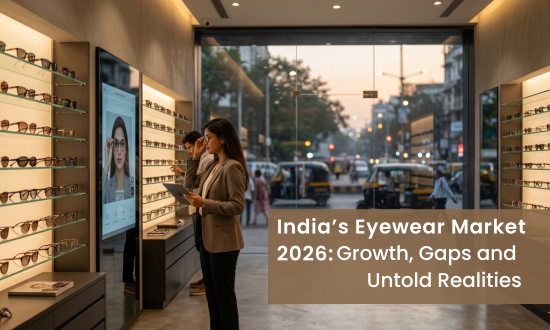

India’s eyewear market is one of the most compelling growth stories in Asian retail. A population exceeding 1.4 billion, a rapidly rising middle class, increasing screen time across age groups, and a long-underserved rural consumer base all point in one direction: sustained, structural demand for eyewear products for decades to come.
Yet the headline growth numbers tell only part of the story. Beneath the market projections lies a more nuanced picture of organised players squeezing independent retailers, of category gaps that remain wide open, of lens and contact lens brands with significant awareness deficits, and of an Indian consumer who, despite growing aspirations, still does not fully understand or invest in their own vision health.
This analysis looks beyond the data. It examines what is actually happening on the ground in Indian optics in 2026, where the genuine opportunities lie, and what brands and industry players need to understand to compete effectively in this market.
1. Market Size and Growth: The Numbers in Context
India’s overall eyewear market was valued at USD 10.4 billion in 2024 and is projected to reach USD 19.6 billion by 2033, representing a compound annual growth rate of approximately 6.94%.
Across sub-segments, growth projections are even more striking. The luxury eyewear segment is growing at nearly 12% annually. Smart eyewear, still nascent in India, is projected to grow at over 31% annually through 2033, off a small base but a clear signal of where younger urban consumers are heading.
India Eyewear Market: Key Segments at a Glance (2024)
| Category | Market Value (2024) | Projected Value | CAGR |
| Overall Eyewear Market | USD 10.4 billion | USD 19.6 billion (2033) | 6.94% |
| Luxury Eyewear Segment | USD 891 million | USD 1.72 billion (2030) | 11.72% |
| Smart Eyewear | USD 87.85 million | USD 1.04 billion (2033) | 31.7% |
| Safety Eyewear | USD 107.2 million | USD 154.8 million (2030) | 6.2% |
These numbers are meaningful. But they require context.
India’s eyewear market growth is driven by genuine structural demand, not discretionary fashion spending. The primary engine is uncorrected refractive error.
India has one of the largest populations of people with untreated vision impairment in the world. Research published in PLOS One covering over 286,000 children found an overall myopia prevalence of 7.5% in the 5 to 15-year-old age group across four decades of data. More recent modelling projects predict that myopia prevalence in urban Indian children will reach nearly 32% by 2030.
Every percentage point of that projection represents a new eyewear consumer. The demand pipeline is not manufactured. It is demographic and clinical.
2. The Organised vs. Unorganised Divide: What the Data Misses
Market research reports present India’s eyewear retail as a growth story across channels. The ground reality is more complicated.
The entry and aggressive expansion of digitally-native organised players such as Lenskart, which now operates over 2,000 stores and added more than 450 locations in FY25 alone, has fundamentally altered the competitive landscape for independent optical retailers.
The Unorganised Market: Smaller Slice, Different Consumer
Independent and small optical retailers in India today largely serve a specific consumer profile: patients above 35 years of age who value personalised dispensing, a longstanding optician relationship, after-sales service, and quality products. It is not only more profitable but their only choice to survive against a growing, organised market.
Having said that, it is as much a gap for independent retailers as it is an opportunity for premium brands and spectacle lenses, who can penetrate the unorganised Indian eyewear market.
These consumers are not the primary target of organised chains, especially Lenskart – targeting a younger audience who want fast fashion that’s affordable.
This is a defensible position, but it is a narrowing one. As each generation of younger consumers is acquired by organised retail, the pipeline feeding independent stores becomes thinner.
There are other retail chains like Titan Eye and Specsmakers, who stand in the middle ground, only squeezing the pipeline further.
Contact lens and sunglass sales have largely migrated away from independent optical stores. E-commerce platforms enable straightforward reordering of monthly and daily disposable lenses without professional consultation. Fast fashion retail has commoditised non-prescription sunglasses entirely – consumers now buy them as fashion accessories on Myntra, Ajio, and Amazon, bypassing optical stores altogether.
The consequence is a self-reinforcing cycle: reduced footfall leads to reduced stock range, which further limits consumer choice at independent stores, which pushes more consumers to online alternatives.
Prescription Sunglasses: The Exception
One category where independent optical stores retain a meaningful position is prescription sunglasses. The clinical requirement for accurate lens prescription keeps this segment within the professional channel. However, reduced sunglasses stock overall at independent stores limits the range available to consumers who do seek prescription options – a gap that represents both a problem and an opportunity.
The Organised Market: Growth Driven by Footfall, Not Necessarily Profit
Organised players dominate consumer mindshare through sustained marketing investment, celebrity endorsements, and aggressive store expansion. Their primary demographic is young consumers aged 15 to 30 who seek trendy, affordable eyewear.
After-sales service and clinical dispensing quality are not the competitive differentiators in this segment – price and accessibility are. Progressive lens dispensing complaints, in particular, continue to be more frequently directed at them than at independent opticians with specialist dispensing expertise.
Beyond Lenskart and Titan, India has several established optical retail chains — Lawrence and Mayo, Himalaya Optical, GKB Opticals, Specsmakers, and others — some carrying decades of legacy and strong regional consumer bases. These players have the product range, the dispensing expertise, and the brand equity to compete effectively. The gap many of them face is digital presence and marketing investment beyond social media.
3. Category Analysis: Underpenetrated India
Ophthalmic Lenses: A Brand Awareness Problem
The ophthalmic lens segment in India is dominated by a small number of international players. Essilor & Zeiss have the strongest brand recognition, built over decades of market presence. Hoya has entered the Indian market with a competitive product range, but has not achieved proportionate brand awareness despite strong lens quality.
Other major international lens manufacturers like Nikon Lenswear and Rodenstock have limited consumer-facing visibility in India. Most consumers purchase lenses on the basis of retailer recommendation rather than brand preference. This creates significant dependency on the optician channel and limits the ability of lens brands to build direct consumer demand.
The opportunity for lens manufacturers is substantial: consumer education and demand generation remain almost entirely undeveloped in India. Unlike markets in Europe or North America, where patients ask for specific lens brands by name, the Indian consumer largely defers entirely to whoever is dispensing. The brand that invests in consumer education first will build a durable advantage.
Contact Lenses: Distribution Is Not Demand
Bausch and Lomb, CooperVision, and Acuvue (Johnson and Johnson Vision) all have distribution presence in India. None of them is actively generating consumer demand at scale.
Contact lens penetration in India remains significantly below its potential. Awareness of daily disposable lens technology, silicone hydrogel materials, and toric lens options for astigmatic patients is low among Indian consumers outside metropolitan areas. The clinical channel – optometrists and opticians – is the primary route to trial and adoption, yet lens brands are not investing in professional education and advocacy at the level the market opportunity warrants.
The comparison with FMCG categories is instructive. Shampoo brands, nutritional supplements, and skincare companies invest heavily in both consumer advertising and professional recommendation channels in India. Contact lens brands operate as if distribution alone generates sales. It does not.
Frames: International Premium Brands Have Not Arrived
India’s frame market is growing, but the premium end of the international market remains largely unrepresented. Numerous European and American premium eyewear brands that perform strongly in Western markets have not entered India. The combination of import duties, distribution complexity, and uncertainty about premium consumer appetite has historically deterred entry.
Both assumptions are increasingly worth revisiting. India’s luxury goods market is growing rapidly. Consumers in metropolitan markets have demonstrated a clear willingness to pay for premium branded products across fashion categories. The eyewear market has not yet seen the equivalent of what happened in luxury watches, handbags, or footwear – but the consumer base that would support it is forming.
There is also a strong concurrent opportunity in the other direction: Indian-made premium eyewear. The Make in India narrative has created genuine consumer appetite for quality homegrown brands across categories. A well-positioned Indian eyewear brand, combining quality manufacturing, strong design, and credible professional endorsement, has a significant first-mover opportunity in the frame market.
Sunglasses: Penetrated at Fashion, Underpenetrated at Quality
The sunglasses market in India is active at the fashion and affordable end. Ray-Ban remains the only international sunglasses brand with genuine mass-market penetration and brand recognition. Other premium international brands like Maui Jim, Oakley at the prescription level, and Persol have limited consumer awareness outside major metros.
The clinical dimension of sunglasses – UV 400 protection, polarisation, photochromic options for outdoor use- is almost absent from consumer marketing in India. Consumers largely buy sunglasses on aesthetics and price. This represents a significant education and premiumisation opportunity for brands willing to invest in that conversation.
4. The Consumer Knowledge Gap: The Most Significant Structural Challenge
Every category analysis above returns to the same underlying issue: the Indian eyewear consumer does not yet understand the value of what they are buying.
Unlike healthcare markets in Europe or North America, where patients arrive with baseline knowledge of product categories and brand options, the Indian optical consumer largely relies on whoever is in front of them at the point of sale. This makes the optician’s recommendation extremely powerful, but it also means that when the optician is replaced by a chain store sales assistant optimising for transaction speed, clinical quality is the first casualty.
The Lens Quality Problem
The most consistent expression of this knowledge gap is the Indian consumer’s reluctance to invest in quality spectacle lenses. Frames are a visible, social purchase. Lenses are invisible and therefore undervalued.
Consumers routinely spend disproportionately on frames while selecting the cheapest available lens option. The clinical reality is that the lens is doing the optical work, and that lens quality directly determines visual clarity, comfort, and long-term eye health outcomes, which is not understood by the majority of Indian eyewear consumers.
This is not a new problem. It is a generational one. When high-quality plastic lenses were introduced in India in the early 2000s to replace glass lenses, adoption took time and required active dispensing advocacy. The transition happened because opticians communicated the safety and quality benefits clearly, and the price differential was manageable. The same model applies to higher-index lenses, anti-reflective coatings, and progressive designs today.
Children’s Eyewear: Where the Knowledge Gap Has the Highest Stakes
The knowledge gap is most consequential in children’s eyewear. Indian parents, when purchasing spectacles for children, overwhelmingly optimise for price. The rationale is understandable: children break frames, outgrow prescriptions quickly, and resist wearing glasses. Why invest in quality when the glasses may not last six months?
The clinical answer is unambiguous. A child’s visual system is in active development through their early teens. The quality of optical correction during this period directly affects visual development outcomes. A child wearing a poorly made lens with significant optical aberration or incorrect prescription is not just seeing badly today – they may be developing compensatory visual habits that affect them long-term.
No brand in the Indian market is currently making this case to parents. It is an entirely open conversation.
The Role of Rising Cost of Living
It would be incomplete to discuss consumer spending on eyewear without acknowledging the macroeconomic context. Global uncertainty, inflationary pressures, and a rising cost of living across Indian urban centres are making consumers more cautious with discretionary spending. Eyewear, though a clinical necessity, is perceived and budgeted as a discretionary purchase by most Indian consumers.
This is the central challenge and the central opportunity simultaneously. When consumers understand that spectacle lenses are not a fashion accessory but a medical device that determines how clearly they experience the world, the conversation about value changes. Budget conversations do not disappear, but they are reframed around informed choice rather than defaulting to the cheapest option.
5. What Independent Opticians and Retail Chains Must Do Differently
For Independent Opticians: Visibility, Retention, and Premium Positioning
The independent optical retailer’s competitive advantage is clinical expertise and personalised service. The challenge is that this advantage is invisible to consumers who never walk through the door.
Regional digital marketing, such as Google Business Profile optimisation, local SEO, and WhatsApp-based customer retention, is the most accessible route to visibility for independent opticians. Most small opticians have no digital presence beyond a basic social media page, if that.
Within the store, the strategy should focus on specialisation. Premium dispensing – progressive lens expertise, myopia management for children, occupational lens solutions commanding margins that commodity eyewear cannot. The independent optician who becomes known in their community as the specialist for complex dispensing needs is not competing with Lenskart. They are serving a different market entirely.
For Established Optical Chains: Digital Visibility Is the Gap
Optical chains with decades of legacy, premium product ranges, and strong dispensing teams are competing with one hand tied behind their back when their digital presence is limited to periodic social media posts.
Brands like Lawrence and Mayo, Dayal Opticals, and more have the credibility, the range, and the expertise to compete directly with organised retail for consumers who prioritise quality and professional service. What they often lack is the digital discoverability that makes their offer visible to consumers researching eyewear online before visiting a store.
Investing in SEO-optimised websites, educational content marketing, and online appointment booking systems is not a luxury for these brands. It is the difference between capturing and losing the next generation of quality-conscious eyewear consumers.
Author’s Perspective: What Twenty Years in Indian Optics Has Taught Me?
The following reflects my personal observations from over two decades working within the Indian optical industry.
India’s eyewear market data looks impressive on the surface. From the inside, the picture is more complicated and, in some ways, more urgent.
What concerns me most is not the competition between organised and unorganised retail. Competition is healthy. What concerns me is the consumer knowledge gap that underlies almost every structural problem in Indian optics.
My father started his optical business in the early 2000s, when glass lenses were still the norm in India. I watched him, conversation by conversation, convince customers to switch to fibre lenses – explaining the safety benefit, the weight advantage, the optical quality. That transition happened because practitioners took responsibility for educating their patients. It was slow. But it worked.
The same transition needs to happen today with lens quality broadly. Indian consumers routinely invest in premium frames and compromise on lenses – the very part of the spectacle that does the optical work. They buy the least expensive lens option for their children at precisely the age when optical quality matters most for visual development.
No brand in India is making this case at scale. Not the lens manufacturers, not the optical chains, not the professional bodies. The consumer education conversation is not happening. And until it does, the market will continue to grow in volume while remaining underdeveloped in value.
The opportunity I see most clearly is this: the brand, the chain, or the platform that invests seriously in building vision health literacy among Indian consumers will not just capture market share. It will shape the market. That work has not yet been done. It is entirely available to whoever chooses to do it first.
References and Data Sources
- IMARC Group. India Eyewear Market Size, Share, Industry Trends, Growth and Research Report 2025–2033.
- MarkNtel Advisors. India Luxury Eyewear Market Report 2025–2030.
- IMARC Group. India Smart Eyewear Market Report 2025–2033.
- Grand View Research / Horizon Databook. India Safety Eyewear Market Outlook 2025–2030.
- Khanal S et al. Prevalence of Myopia in Indian School Children: Meta-analysis of the Last Four Decades. PLOS One, 2020.
- Research and Markets. Eyewear in India 2025 Industry Report.
- Exchange4media. The Great D2C Reset: How 2025 Merged Offline and Online Commerce. December 2025.
- CBRE India. India’s D2C Revolution: The New Retail Order. 2025.
- Custom Market Insights. India Eyewear Market Size, Trends, Share and Forecast 2033.
- Lenskart Store Expansion — Business Standard