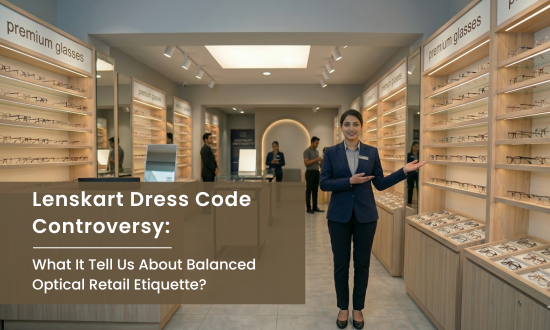

In April 2026, a dress code document linked to Lenskart went viral on social media. It created a sharp public debate about workplace identity, inclusion and professional standards in Indian retail.
The company responded, acknowledged the issue and revised its policy. That chapter is closed.
But the conversation it started is worth continuing. Because the question at the heart of it applies to every optical retailer in India, regardless of size or scale.
How do you build a professional retail environment that respects individual identity and consistently delivers a great consumer experience?
That is what this article addresses.
1. Why Appearance Policy Matters in Optical Retail
Optical retail is not like most retail categories.
It sits at the intersection of fashion and healthcare. Consumers walk in for a clinical consultation and leave with a product they wear on their face every day.
Trust is built quickly or not at all. Within minutes of entering a store, a patient is forming a judgement. Is this person knowledgeable/trustworthy? Do I feel comfortable here?
Everything in the environment contributes to that judgement. The store layout. The greeting. The appearance and demeanour of the person in front of them.
Appearance policy in optical retail is therefore not a minor administrative matter. It directly shapes the consumer experience. Getting it wrong has consequences that extend well beyond the internal team.
2. The Problem with Over-Prescriptive Policies
When a dress code attempts to regulate every visible detail of an employee’s appearance, two things happen.
First, inconsistencies surface. If the policy treats different groups differently, even unintentionally, it is no longer about professionalism. That distinction carries both ethical and legal weight.
Second, over-prescription creates fragility. The more detailed a policy, the more opportunities it creates for unintended bias to appear.
HR professionals consistently advise that simpler, outcome-focused dress codes result in fewer complaints and stronger employee engagement. The more generalised the guideline, the less room there is for bias, and the easier it is to apply fairly across a diverse team.
3. What a Good Dress Code Actually Looks Like
Professional standards in optical retail come down to a small number of clear principles. None of them requires regulating how an employee expresses their cultural or personal identity.
Standards That Matter
- Uniform or branded attire kept clean, pressed and well-fitted
- Personal grooming is maintained to a high standard at all times
- Footwear is clean, closed-toe and appropriate for a clinical retail setting
- Jewellery is minimal and unobtrusive to work tasks
- Overall presentation consistent with the brand’s professional image
These apply equally to every team member. They focus on cleanliness, consistency and brand alignment. They say nothing about personal belief or cultural background.
What Does Not Belong in a Dress Code
- Rules that apply differently to different cultural or faith-based groups
- Restrictions on any form of personal or religious expression
- Requirements that ask employees to suppress visible markers of their identity
A simple test: does this rule apply equally to everyone on the team, regardless of their background? If not, it needs to be rewritten.
The Two-Zone Framework for Optical Retail Dress Codes
| Policy Area | Non-Negotiable Standard | Flexible Zone |
| Uniform | Clean, branded, well-fitted attire | Colour options within the brand palette |
| Personal expression | No restrictions on any cultural or faith-based expression within professional decorum limits | Size and placement kept unobtrusive |
| Hair & Make-up | Minimal, clean and well-groomed at all times. Hair colours & make-up must maintain a professional demeanour | Style, length and covering at employee discretion |
| Jewellery | Minimal and unobtrusive to work tasks | Style & colour at employee discretion |
| Footwear | Closed-toe, clean, professional. Colour as per brand palette. | Brand or style at employee discretion |
4. Identity as a Business Asset
There is a clear business case for inclusive dress codes that goes beyond ethics.
India is one of the most culturally diverse retail markets in the world. A team that reflects that diversity builds faster trust with a broader consumer base.
When a consumer walks in and is served by someone whose background or culture they recognise, there is an immediate moment of comfort. That comfort reduces hesitation, builds rapport and moves the clinical conversation forward.
Brand cohesion comes from consistent service quality, a clean environment and knowledgeable staff. It does not depend on suppressing the identity of the people delivering it.
5. Consumer Experience: Where It Is Really Won or Lost
A dress code is the most visible element of retail professionalism. But the consumer experience is shaped by far more than how the team looks.
Optical retail involves a level of clinical trust that most retail categories do not. A patient is sharing their vision concerns and relying on a professional’s recommendation. Every interaction either builds or erodes that trust.
The Behaviours That Define the Experience
Before the consultation:
- Greet every customer within 30 seconds of entry. Do not wait for them to approach the counter.
- Acknowledge walk-ins even when the store is busy. A brief nod or “I’ll be with you shortly” removes uncertainty.
- Ensure the store is clean, well-lit and organised. The physical environment communicates quality before a word is spoken.
During the consultation:
- Listen fully before recommending. Understand what the patient actually needs, not what is easiest to sell.
- Explain findings and recommendations in plain language. Avoid jargon that creates distance.
- Never make a consumer feel judged for their budget. Present options across price points without signalling preference based on spend.
- For progressive lens consultations, always conduct a lifestyle profile before selecting a lens design. The consultation itself is part of the experience.
After the sale:
- For first-time progressive lens wearers, counsel on adaptation before they leave. Set realistic expectations clearly.
- Follow up within two weeks of dispensing. A brief call or message asking about comfort and fit makes a lasting impression.
- Handle complaints calmly and with a genuine intent to resolve. A well-handled complaint builds more loyalty than a smooth sale.
Closing Perspective
The conversation sparked by the Lenskart episode was uncomfortable for the industry. It was also necessary.
How a retail brand treats its employees is visible to the consumers they serve. A policy that asks employees to conform at the cost of their identity sends a signal. That signal is felt both inside and outside the organisation.
The middle ground is straightforward. Define the professional standard clearly. Leave identity decisions to your people. Judge the output by one measure: did the consumer leave better served than when they arrived?
If the answer is yes, the policy is working.
References and Sources
- Opindia. Lenskart CEO Admits Outdated Style Guide Flagged Tilak and Bindi but Permitted Hijab. April 2026. https://www.opindia.com/2026/04/lenskart-ceo-admits-outdated-style-guide-flagged-tilak-bindi-but-permitted-hijab-what-peyush-bansal-said-and-what-the-feb-2026-document-reveals/
- Business Today. Lenskart CEO Peyush Bansal Clarifies as Document on Dress Code Policy Goes Viral. April 2026. https://www.businesstoday.in/latest/trends/story/not-our-current-guidelines-lenskart-ceo-peyush-bansal-clarifies-as-document-on-dress-code-policy-goes-viral-526070-2026-04-16
- SHRM. The Role of Dress Codes in Creating an Inclusive Work Environment. March 2025. https://www.shrm.org/topics-tools/news/role-of-dress-codes-creating-inclusive-work-environment
- SHRM. Shifting Trends Spotlight Need for Alignment of Dress Code and Culture. April 2025. https://www.shrm.org/enterprise-solutions/insights/shifting-trends-spotlight-need-alignment-of-dress-code
- BambooHR. How to Create an Inclusive Workplace Dress Code Policy. 2025. https://www.bamboohr.com/blog/workplace-dress-code-policy
- Built In. Dress Code Policy: What It Is, How to Make One. 2025. https://builtin.com/company-culture/dress-code-policy
- PayEscape. Workplace Dress Code: Diversity, Inclusion and Professional Standards. 2025. https://www.payescape.com/blog/workplace-dress-code
- Indeed. What Is a Dress Code Policy? 2025. https://www.indeed.com/hire/c/info/dress-code-policy